The Ultimate Guide to Choosing the Right Hay for Your Livestock in Washington State
Choosing hay in Washington is less about a single “best” bale and more about a match: the animal in front of you, the cutting in the stack, and a climate that can go from dry heat to a wet, cold winter in the same year. Whether you keep horses in the Tri-Cities, a few goats, or cattle as well, the decision process is the same. Know the types, inspect the hay, and buy from someone who can tell you what you are actually getting.
This is the Washington-focused choosing guide — written from a Pasco hay farm, for people who feed animals here. If you landed on an older “hay in Seattle” or “hay in Portland” article of ours, this is the page that should replace it. We grow hay in Eastern Washington, and this is the advice that matches that fact.
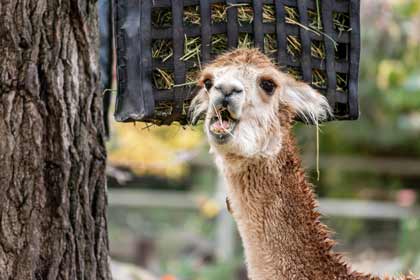
(LLama with hay feeder)
Start with the animal, not the aisle of pretty bales
A hard keeper, a senior with poor teeth, an easy-keeping pony, a pregnant mare, a dairy cow, and a goat do not want the same forage, even if they all “eat hay.” Ask, in this order:
- What species, and how many?
- Are they easy keepers or hard keepers? Growing, pregnant, lactating, or in work?
- Any metabolic, respiratory, or dental issues? (For horses, this is often the whole conversation.)
- How will you store the hay, and how much can you keep dry?
Only then does “alfalfa or grass” become a useful question.
The main types you will see in this region
Timothy grass hay
Timothy is a classic horse hay: a grass forage many owners trust as a daily base, and often a go-to when they want a lower-sugar option. Later cuttings tend to be leafier and more of a “horse cutting” than a mature, headed first cut. See our timothy grass hay for what we have in the barn.
Orchard grass hay
Orchard grass is typically soft, leafy, and palatable, with a lot of fiber and, in many lots, a lower sugar profile that suits horses. It is a daily-driver grass hay for a lot of Eastern Washington barns. Look at our orchard grass hay if that is the direction you are heading.
Alfalfa
Alfalfa is a legume, usually higher in protein and calcium, and often richer than grass hay. It can be an excellent choice for hard keepers, some seniors, growing animals, and livestock that need more from every bite. It is not automatically the right hay for an easy keeper or a horse whose veterinarian is watching sugar, weight, or metabolic health. First-cutting alfalfa is often stemmier than later cuttings; both can be useful in the right stall. We sell alfalfa and 1st cutting alfalfa.
Orchard-alfalfa mix
A mix aims for the middle: grass fiber and palatability with some of alfalfa’s protein and heft. Many horse owners like it as a balanced option when straight alfalfa is more than they need and straight grass is not quite enough. Our orchard grass/alfalfa mix is built for that job.
Feeder hay
Feeder hay is a more economical option for cattle and other livestock that do not need horse-quality forage. It still needs to be sound — not moldy, not heated — but it is not the same product as a leafy horse cutting. See feeder hay if that is what your animals actually require.
Cuttings change the hay as much as the species does
First cutting is often coarser and higher in fiber. Later cuttings are often leafier, softer, and more nutrient-dense. That is a general pattern, not a guarantee; maturity at harvest and how the hay was cured matter just as much. For horses, “which cutting” is often the difference between a hay that keeps an easy keeper busy and a hay that puts weight on a hard keeper. We go into that in first cutting vs. late-season hay.
How to judge a bale before you buy it
No type name will save you from a musty, dusty, or wet bale. Check color inside the bale, smell, leaf, moisture, and junk. Ask what it is, which cutting, how it was stored, and whether a forage test exists if your animals need one. Our premium hay checklist and testing guide are the deeper versions of that process.
Buy from a local grower when you can. You will get better answers and an easier path if something is wrong. Our Eastern Washington buying guide is written for that search.
Matching hay to horses, and to everyone else
For most horse owners we talk to, a clean grass hay is the foundation. Alfalfa or a mix comes in when the horse needs more calories or protein, not because alfalfa is “the good stuff” and grass is an afterthought. Seniors may need softer, leafier hay they can chew. Metabolic horses may need a tested, lower-sugar grass hay — a conversation to have with your veterinarian, then with your hay supplier.
Goats often prefer leafy hay and will waste coarse stems. Cattle can use a wider range, including feeder hay, depending on class and production. Small animals generally need fine, clean, palatable hay. If you feed more than one species, you may need more than one stack, labeled clearly, rather than one compromise bale that nobody is happy with.
Washington weather belongs in the decision
In Eastern Washington you will feed more hay in the cold months, and you will need storage that can take rain and wind without ruining the quality you just paid for. Choose a type you can buy again mid-winter if you must, and only buy as much as you can keep dry. A perfect cutting left on bare ground is no longer a perfect cutting. Plan the barn as part of choosing the hay.
Frequently asked questions
Is alfalfa or timothy better for horses?
Neither is better in every stall. Timothy (and orchard grass) is the everyday forage for many horses. Alfalfa is richer and can be the right tool for horses that need more. The horse in front of you, and sometimes a hay test, should decide.
I used to buy hay in Western Washington or Oregon. Does that change anything?
The types are similar; the growing conditions and the suppliers are not. Shop local Eastern Washington hay on its own merits, and inspect it the same way. Do not assume a brand or a region name is a substitute for opening a bale.
Can I feed the same hay to horses and cows?
Sometimes, if the hay is clean and the horses’ needs are modest. Often you will do better with a horse-quality grass hay for the horses and a sound, more economical hay for the cattle. Ask, rather than forcing one product to do every job.
How do I choose if I am new to this?
Tell a local grower how many animals you have, what they are, and any health issues you know about. Start with a clean grass hay for most horses, inspect the load, and keep notes on how they do. You do not have to become a nutritionist overnight, but you do have to look at the hay and watch the animals.
If you want help choosing, contact Ohana Farms or browse The Hay Barn. We will tell you what we have in Pasco right now and help you match it to the animals you actually feed.